Prevent Storm Damage with Tree Cable and Bracing
Last November, a client called just after midnight. A Pacific squall had rolled through with 60 mile-per-hour gusts and their 80-year-old sugar maple was shifting hard over the driveway. We found a classic problem at the top of the trunk, a wide V-shaped union with bark included between two leaders. One side had already started to split along the seam. We reduced the crown, installed a pair of extra-high-strength cables near the upper canopy, added a brace rod through the union, and cleared a few compromised branches. The tree rode out the winter without losing another inch. The car parked beneath it was fine. So was the tree.
That is what Tree Cable and Bracing is for, not to make a risky tree perfectly safe, but to reduce the likelihood and consequences of failure. Used thoughtfully, and paired with Tree Pruning & Crown Shaping, it can protect mature trees from storm damage while keeping yards, people, and structures out of the collapse zone.
Why trees fail in storms
Wind exposes every weak decision a tree has made over decades. The physics is simple, yet the failures vary.
- Wind sail and leverage: A dense upper crown catches wind like a sheet, and every foot of height multiplies bending forces at the trunk and roots. Wet foliage, late leaf retention, and ice accretions amplify loads.
- Structural defects: Codominant stems with bark inclusion, overextended lateral limbs, old heading cuts, and decay columns all concentrate stress. A narrow union can behave like a pre-scored hinge.
- Root and soil problems: Saturated soils loosen the root plate. Root rot in conifers, cut roots along a driveway, or a compacted lawn that starved roots of oxygen leaves a tree with less anchorage than it appears to have.
- Species tendencies: Silver maples, Bradford pears, and willows often hold tensile wood poorly across unions. Many conifers, from Douglas-fir to spruce, shed whole tops rather than single limbs. Oaks are better compartmentalizers of decay, but even they can tear out where torsional loads peak.
When these factors stack up near a home, patio, or power lines, storms turn from weather to liability.
What cabling and bracing actually do
Cabling and bracing are structural supports installed by arborists to redistribute mechanical loads and limit movement where trees are most likely to split.
- Cabling uses high-strength steel strand or synthetic rope to tie two or more branches together. The anchor points are set in sound wood and positioned to reduce oscillation. Guidelines from ANSI A300 Part 3 describe placements, materials, and installation practices that reputable firms follow.
- Bracing involves solid steel rods through the trunk or limb union to prevent separation. Rods take shear loads, where cables mostly handle tensile loads and movement.
There are two broad approaches. Static systems use steel cable that allows little movement, which is useful when a union is already weak. Dynamic systems use specialized synthetic lines with controlled stretch that let the tree move, strengthening wood while damping peak loads. Both systems require anchors, proper termination hardware, and precise positioning. Installed correctly, a support system acts like a seatbelt for the canopy, not a cast.
An important boundary: cabling and bracing do not cure decay, reattach torn wood, or guarantee safety. They mitigate risk when paired with pruning and ongoing inspections. On severely compromised trees over critical targets, removal remains the ethical call.
When supports are the right choice
Judgment starts with targets and consequences. If a failure would land across a busy sidewalk, bedroom, or service drop, the bar for preserving a flawed tree is high. Many mature trees are candidacies for Tree Cable and Bracing when any of the following are true:
- A codominant union with bark inclusion shows no active cracking, and the stems carry significant shared canopy.
- An overextended lateral limb, often above a driveway, is otherwise healthy but carries more weight than its wood can safely support in wind or snow.
- A historically significant or high-value tree is structurally imperfect yet retains sound wood around proposed anchors.
Conversely, we recommend Dangerous Tree Assessment and Removal when the trunk has advanced decay at the base or primary unions, when root plate stability is undermined, or when failure would present unacceptably high risk and the tree lacks the vigor to respond to pruning.
I have declined to cable a fir with a hidden heart rot column discovered by a resistograph, even though the homeowner wanted to try every measure first. The tree was tall, leaned 8 degrees toward the nursery, and the decay extended through more than half the diameter for at least six feet. A cable would have given false confidence. We removed the tree and used Stump Removal & Grinding to prepare the spot for a new, wind-firm serviceberry.
The role of a Certified Arborist Consultation
Support systems begin with assessment. During a Certified Arborist Consultation, we look at species, age class, site exposure, soil, and targets. We probe unions, listen for hollow sections with a mallet, and, when needed, use instruments like a resistograph to understand internal wood density. We map defects relative to expected load paths and look at past pruning cuts that may have redirected growth.
We also talk about goals. If a client values shade over the deck but is open to selective thinning, a lighter reduction paired with a dynamic cable might be appropriate. If the concern is a bedroom directly beneath an overextended limb, we may combine a modest end-weight reduction with a static support and a brace rod through the union. Everything flows from risk tolerance and what the site allows.
How we install support systems with care
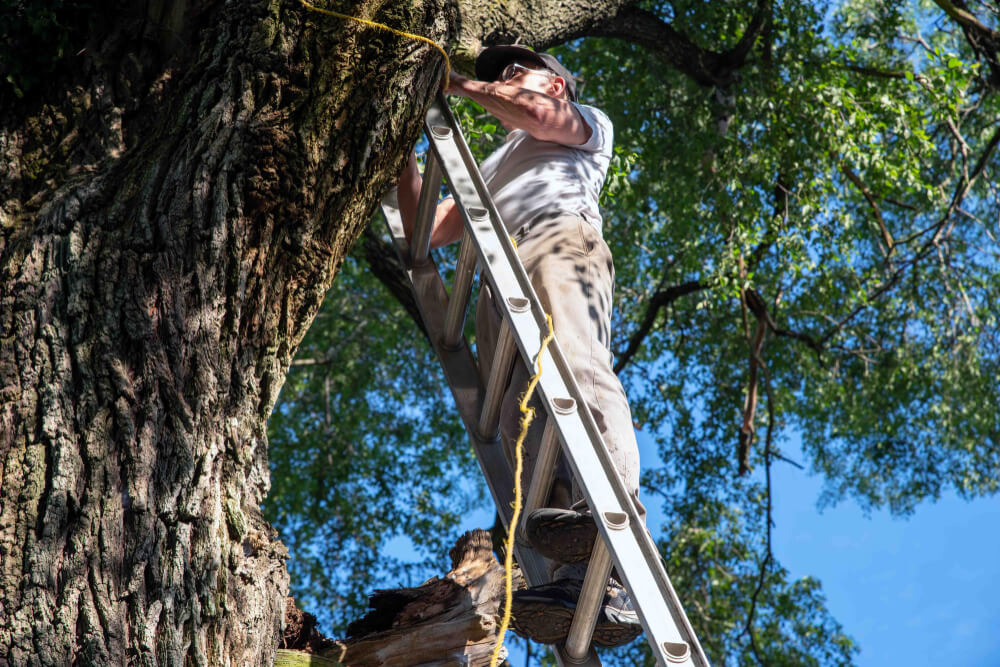
Cabling and bracing look simple from the ground, yet execution matters. A cable two feet too low or a rod set through compromised wood can fail when the tree needs it most. The following overview describes how a professional crew approaches a typical installation on a healthy but structurally challenged hardwood. Use it as a sense of process, not a DIY guide.
- Inspect and plan: Confirm defect type, choose static or dynamic hardware, and mark anchor points in sound wood, typically in the upper third to upper half of the canopy and roughly two-thirds of the distance from trunk to branch tips for cabling. For bracing, identify the union’s pivot line and plan rod placement perpendicular to expected separation.
- Prune first: Reduce sail and end weight before installing hardware so the final load profile reflects the supported tree, not the pre-pruning shape. We often remove 10 to 20 percent of foliage in the upper canopy, focusing on thinning and selective reduction cuts without lion-tailing.
- Set hardware: For static steel, install lag hooks or through-bolts per ANSI practices, then attach extra-high-strength cable with thimbles and dead-end grips. For dynamic systems, drill and set expansion anchors or wrap-approved slings, then terminate with prescribed connectors. Brace rods go through drilled holes with washers and nuts sized to the diameter and defect.
- Tension and test: Bring the cable to tension that limits excessive movement without trussing the canopy tight. The goal is shared load, not immobilization. Check symmetry, verify no hardware binds, and ensure bark grows freely around fixtures.
- Document and schedule: Record hardware specs, installation dates, and inspection intervals. Mark follow-up after significant storms or within 12 to 24 months, sooner for high-risk sites.
Anchors require sound wood. On hardwoods, lag hardware can be appropriate if the anchor point is not prone to splitting and the diameter is sufficient. Through-hardware spreads load better on softwoods or where long-term expansion is expected. Spacing brace rods as a system through the union rather than relying on a single rod distributes shear and is more durable.
Pairing supports with Tree Pruning & Crown Shaping
A cable without crown work is like a seatbelt without brakes. We almost always prune before we install hardware. The priorities:
- Reduce leverage. Shorten overextended laterals by 10 to 15 percent at appropriate laterals.
- Thin with restraint. Remove small-diameter interior branches causing sail, but keep foliage along the length of limbs to maintain taper. Lion-tailing builds breakage later.
- Clean out defects. Take out dead, cracked, or rubbing wood. Correct poor past heading cuts that sprouted weak attachments.
- Respect timing. On oaks and elms in beetle-prone regions, prune during dormancy or outside peak insect activity to limit disease spread. In hot, dry summers, lighter pruning protects trees from stress.
We shape to the tree’s architecture, not a generic silhouette. Once growth responds, return visits keep the structure aligned with safety goals.
Integrating FireSmart Tree Services
In fire country, structure matters as much for embers and radiant heat as for wind. FireSmart Tree Services layer on different, though related, objectives:
- Maintain vertical separation between surface fuels and lower branches to break the ladder effect. This often means raising crowns modestly around structures while preserving interior foliage for branch strength.
- Provide horizontal spacing between canopies where possible. Crowns that do not touch are less likely to torch collectively.
- Manage debris. Chips and small wood should be cleared away from structures rather than piled beneath drip lines near foundations or decks.
Cables and braces can coexist with FireSmart practices, but hardware should not trap needles or debris that might ignite. Regular cleaning and inspection matter. Where a cable crosses near a roof, keep fuels off the structure and assess any potential ember lodging points.
Cost, timelines, and what to expect
On a typical two-leader hardwood with one cable and a brace rod, a professional installation with pruning often runs in the range of $950 to $2,500, depending on access, height, and hardware type. Dynamic systems may cost a little more in materials, less in drilling time. Complex multi-cable installations in tall conifers can exceed $3,000, especially if a crane or specialized rigging is required. A Certified Arborist Consultation often ranges from $100 to $300, sometimes credited against the work if you proceed.
Expect a half day to a full day on site for a single tree. Our crew usually includes two to three arborists, a climber, and a ground technician for rigging and cleanup. We bring insulated throwlines, climbing gear, drilling systems with sharp bits sized to the hardware, and appropriate cable kits. If your tree is near power lines, coordination with the utility is mandatory. Add lead time for that step.
After installation, plan on inspections at least every other year, and any time a major wind event passes through. Hardware lasts many seasons, but trees grow. That new growth shifts loads and can swallow fittings if we do not adjust or replace parts.
Emergency Tree Services and storm triage
When storms win, safety comes first. We run Emergency Tree Services during and after high wind events. Often the right call is immediate scene management rather than complete resolution. That can look like removing a hung limb, relieving weight off a split union to keep the rest of the crown intact, or tarping a roof after a break. Once the scene is safe, a measured plan follows.
Occasionally, a tree that might have been a good cabling candidate is so cracked or twisted after a storm that it should be removed. Dangerous Tree Assessment and Removal then proceeds with controlled rigging or crane assistance, keeping targets protected. After removal, Stump Removal & Grinding prepares the site for replanting. We usually recommend replanting with wind-firm choices appropriate for the site, such as serviceberry, ginkgo, katsura, or a native conifer where space allows.
A tale of two choices
Two cases show how similar-looking problems lead to different solutions.
A mature silver maple shaded a duplex parking area with two leaders that formed a flat V. No visible crack, but the union had bark inclusion and the right leader carried more than half the canopy over the asphalt. The homeowners did not want to lose shade. We reduced the right leader’s end weight by about 15 percent, installed two static cables near the top of the canopy to share movement across both leaders, and set a 5/8 inch brace rod through the union with wide washers to distribute shear. We scheduled inspections every 18 months. Five years on, after three notable windstorms, the union still holds tight and growth around the rod is even.
Across town, a bigleaf maple leaned over a workshop with mushrooms at the base in autumn. A quick mallet test sounded hollow. The resistograph suggested a decay column that left less than a third of sound wood around much of the circumference, a poor ratio for hinge strength. Cabling would have done little to counter the base weakness. We recommended removal and used precise rigging to protect the workshop. The client replanted with a smaller native tree and added a trellis for shade in summer. It was not the romantic answer, yet it was right for the site.
Homeowner checklist before a storm season
- Walk the drip line and look up for deadwood, long overextended limbs, or unions that form a tight V.
- Note changes: new mushrooms at the base, heaving soil, fresh cracks, or sappy streaks below unions.
- Map targets: vehicles, sleeping areas, play spaces, and service drops near suspect limbs.
- Schedule a Certified Arborist Consultation to prioritize pruning or supports well before peak wind months.
- Clear the landing zones: move furniture and grills out from under heavy limbs when storms are forecast.
A simple walk-around twice a year catches many problems early, long before the forecast shows trouble.
Myths, mistakes, and edge cases
Not all supports help. The most common do-it-yourself mistake is attaching rope or chain around limbs without anchors. This girdles the cambium, weakens attachment points, and sets up catastrophic failure later. Another error, even among inexperienced crews, is overtensioning cables until the canopy is locked tight. Trees must move. Micro-movements encourage reaction wood that strengthens attachments. Locking a canopy creates hinge points lower down where wood is not prepared to flex.
Hardware selection matters. Galvanized steel holds well when sized correctly, but it still corrodes. In coastal environments, salt accelerates deterioration. Stainless fittings in key spots are worth the cost, or choose dynamic systems specified for the exposure. Avoid placing anchors too close to the union or too near the bark edge where wood thickness is limited.
Cabling does not substitute for resolving targets. If a child’s swing hangs from the same limb you plan to cable, the daily cyclical loading can defeat your best setup. Move the swing, shift parking habits, or take back the limb further. Risk is a system, not a single device.
Finally, know that wildlife value intersects with safety. In some cases, a partially hollow tree with no targets can be left to support cavity nesters, while an equivalent tree near a patio should not. We balance ecological value with site use.
Choosing a provider you trust
Look for an ISA Certified Arborist who references ANSI A300 standards without prompting, carries proof of insurance, and can explain choices in terms you understand. Ask for photos of similar installs and references after storms, not just on clear days. A provider should be as comfortable recommending careful Tree Pruning & Crown Shaping as they are proposing Tree Removal Services when risk justifies it. They should also brief you on follow-up, offering maintenance inspections rather than a one-and-done install.
If wildfire risk is part of your context, ask how their FireSmart Tree Services align with supports, especially around roofs and eaves. If you live on a hilltop or in a wind corridor, talk about species-specific behavior. A robust plan accounts for where you live, not just what you plant.
What inspection and maintenance look like over time
Supports are not install and forget. Growth lifts anchor placements relative to the union, cables stretch, and storms test every decision. We recommend an inspection after the first full growing season, then on a 12 to 24 month interval, and after any storm that produces branch failures elsewhere in the neighborhood. We look for crushed bark at fittings, corrosion, elongation of dynamic lines, and shifts in load now that the tree has grown.
Pruning remains part of the rhythm. Light, periodic work keeps sail balanced so the cable is a safety net rather than the only thing holding a union together. If a cable begins carrying too much load due to uneven growth, we rebalance the crown and adjust tension. Over many years, a well-maintained cable system blends into the tree’s structure, and growth wood reinforces the supported union.
Where removal remains the right call, and what follows
Some trees have moved past the point where supports make sense. Advanced decay at the root collar, repeated fungal fruiting bodies that indicate https://medium.com/@dearusexwk/urban-tree-removal-services-with-minimal-disruption-20ce5fbf6ec7 aggressive heart rot, severe leans that worsened within a single season, or continuous cracking sounds during moderate wind all signal imminent failure. When the consequences beneath are significant, we move to Dangerous Tree Assessment and Removal.
Removal done carefully respects what remains on site. We often stage brush for chip removal that same day, lower rounds onto mats to protect turf, and grind stumps to a depth that supports turf or replanting without settling holes. Stump Removal & Grinding is not glamorous, yet it sets the stage for fresh growth and restores use of the space quickly. Replanting with a smaller-mature tree or a species with stronger unions can return shade and wildlife value within a few seasons.
Bringing it together
Cabling and bracing do not keep wind out of a neighborhood. They shift outcomes. The difference between a branch oscillating freely and a branch whose movement is coupled to its neighbor can be the difference between a tear-out in October and another season of shade. The tactic complements the basics: smart species selection, decent soil, good watering through drought, and thoughtful pruning that respects how trees grow wood.
A calm, professional approach makes the work feel surprisingly routine. We assess, we prune, we support, and we return to check our work. When a nor’easter or atmospheric river lines up with your street, that preparation quietly lowers the odds that your driveway, roof, or fence becomes the story. If you are unsure where to start, schedule a Certified Arborist Consultation. A short visit will tell you whether Tree Cable and Bracing fits your trees or whether a different path, from modest crown work to removal and replanting, will serve you better.
Ace Tree Services Ltd.
Name: Ace Tree Services Ltd.Address: 4656 Wallace Hill Road, Kelowna, BC
Postal code: V1W 4C2
Phone: 250-212-9593
Website: https://acetree.ca/
Hours:
Monday: 7:00 AM - 5:00 PM
Tuesday: 7:00 AM - 5:00 PM
Wednesday: 7:00 AM - 5:00 PM
Thursday: 7:00 AM - 5:00 PM
Friday: 7:00 AM - 5:00 PM
Saturday: 7:00 AM - 5:00 PM
Sunday: Closed
Open-location code (plus code): RHF8+8G Kelowna, British Columbia, Canada
Map/listing URL: https://www.google.com/maps/place/Ace+Tree+Services+Ltd./@49.8232606,-119.4337283,659m/data=!3m2!1e3!4b1!4m6!3m5!1s0x537d8b1d074815c5:0x450b88afa7a41435!8m2!3d49.8232606!4d-119.4337283!16s%2Fg%2F11ydkpnh22
Embed iframe:
"@context": "https://schema.org", "@type": "HomeAndConstructionBusiness", "name": "Ace Tree Services Ltd.", "url": "https://acetree.ca/", "telephone": "250-212-9593", "address": "@type": "PostalAddress", "streetAddress": "4656 Wallace Hill Road", "addressLocality": "Kelowna", "addressRegion": "BC", "addressCountry": "CA" , "openingHoursSpecification": [ "@type": "OpeningHoursSpecification", "dayOfWeek": "https://schema.org/Monday", "opens": "07:00", "closes": "17:00" , "@type": "OpeningHoursSpecification", "dayOfWeek": "https://schema.org/Tuesday", "opens": "07:00", "closes": "17:00" , "@type": "OpeningHoursSpecification", "dayOfWeek": "https://schema.org/Wednesday", "opens": "07:00", "closes": "17:00" , "@type": "OpeningHoursSpecification", "dayOfWeek": "https://schema.org/Thursday", "opens": "07:00", "closes": "17:00" , "@type": "OpeningHoursSpecification", "dayOfWeek": "https://schema.org/Friday", "opens": "07:00", "closes": "17:00" ], "geo": "@type": "GeoCoordinates", "latitude": 49.8232606, "longitude": -119.4337283 , "hasMap": "https://www.google.com/maps/place/Ace+Tree+Services+Ltd./@49.8232606,-119.4337283,659m/data=!3m2!1e3!4b1!4m6!3m5!1s0x537d8b1d074815c5:0x450b88afa7a41435!8m2!3d49.8232606!4d-119.4337283!16s%2Fg%2F11ydkpnh22"
Ace Tree Services Ltd. provides professional tree removal, pruning, stump grinding, emergency response, and arborist consultations for properties in Kelowna and across the Okanagan Valley.
The company works with homes, commercial properties, and municipal settings where tree work needs to be planned carefully around buildings, fences, driveways, landscaping, and other site constraints.
Based in Kelowna, the team is positioned to help nearby neighbourhoods and surrounding Okanagan communities with routine tree care and time-sensitive storm cleanup.
Customers looking for careful tree work often want a crew with certified arborist training, insurance, and a methodical approach to higher-risk removals.
Services also include dangerous tree assessment, cabling and bracing, and wildfire risk reduction tree work for properties that need longer-term planning.
To request a quote or discuss tree care options, call 250-212-9593 or visit https://acetree.ca/.
A public map listing is available to help customers confirm the business location and get directions before a site visit or estimate.
For Kelowna property owners who need pruning, removals, or emergency tree help, a local tree service can make it easier to schedule site-specific recommendations and cleanup.
Popular Questions About Ace Tree Services Ltd.
What services does Ace Tree Services Ltd. provide?Ace Tree Services Ltd. lists tree removal, stump removal and grinding, tree pruning and crown shaping, emergency tree service, arborist consultation, dangerous tree assessment and removal, cabling and bracing, and wildfire risk reduction tree work.
Who does Ace Tree Services Ltd. serve?
The company describes its work as serving homes, businesses, and municipalities in Kelowna and across the Okanagan Valley.
Is emergency tree help available?
Yes. Emergency service is listed for downed or uprooted trees, dangerous tree assessment, stabilization work, and branch cleanup. If a tree is near power lines, the safest first step is to stay clear and contact the utility provider before any tree work begins.
Do I always need a permit to remove a tree?
Not always. Permit requirements can depend on where the tree is located and whether it is near a creek, lake, steep slope, or another protected area. It is best to check local rules for the specific property before removal work starts.
How deep does stump grinding usually go?
Standard stump grinding is typically described as going about 6 to 12 inches below ground level, which is often enough for grass or surface landscaping. Deeper grinding may be possible when site plans call for it.
How much of a tree can be safely removed at one time?
That depends on the species, age, health, and structure of the tree. In practice, good pruning is usually about removing the right limbs for health, clearance, and structure rather than chasing a fixed percentage.
What are common signs that a tree may be dangerous?
Large dead limbs, visible cracks, a new lean, root damage, canopy dieback, or storm-related damage can all be warning signs. Trees near structures deserve extra attention when any of those issues appear.
What is cabling and bracing in tree care?
Cabling and bracing are support systems used to reduce the risk of failure in trees with structural weaknesses that may still be worth preserving. They are generally used to add support, not to replace good assessment and ongoing maintenance.
How do I contact Ace Tree Services Ltd.?
Call 250-212-9593.Website: https://acetree.ca/.
Landmarks Near Kelowna, BC
Downtown KelownaThe downtown core is a practical reference point for lakefront neighbourhoods, mixed-use streets, and central residential properties. If your property is near downtown, tree pruning, removals, and cleanup can be planned around tighter access and nearby structures.
Knox Mountain Park
This well-known park north of downtown is a recognizable landmark for nearby homes and hillside properties. If you are close to this area, ask about tree assessment, trimming, or removal work suited to sloped sites.
Mission Creek Greenway
The greenway runs through several parts of Kelowna and is a useful landmark for nearby residential areas. If your property borders or sits near this corridor, site-specific tree planning is especially important.
Pandosy Village
Pandosy is one of Kelowna’s most recognizable neighbourhoods and a common reference point for south-central properties. If you are nearby, request help for pruning, removals, or storm cleanup around homes and small commercial sites.
Rutland
Rutland is a major east Kelowna neighbourhood with a mix of residential and local commercial properties. If you are located in or near Rutland, tree work can be scheduled for both routine maintenance and urgent situations.
Landmark District
This central business-focused area is a practical landmark for offices, service properties, and nearby residential streets. If your site is near the district, ask about careful tree work around parking, access lanes, and built-up lots.
Kelowna’s North End
The North End sits on the edge of downtown and is a useful reference for nearby homes, industrial sites, and commercial properties. If you are in this part of the city, request tree care based on the layout and constraints of the lot.
Airport District
The Airport District is a recognizable north Kelowna reference point for surrounding properties and access routes. If you are in this area, ask about tree services for residential acreage, commercial sites, or roadside cleanup needs.
Glenmore & Dilworth
These established Kelowna neighbourhoods are useful landmarks for central and north-central service calls. If your property is nearby, pruning and removal work can be tailored to mature trees and established landscapes.
Highway 97 Corridor
Highway 97 is one of the city’s main travel routes and a common way to describe location within Kelowna. If your home or property is just off the corridor, a clear landmark reference can help speed up quote scheduling and site planning.