Evidence-Based Dangerous Tree Assessment and Removal
Trees fail for reasons that rarely show themselves at a glance. A minor lean that held for years can turn into a hinge failure after one night of rain and wind. A small cavity at the base can hide a column of decay running twenty feet up the stem. I have stood in yards on calm mornings, looking at split leaders that survived a storm only by luck. Good judgment, not guesswork, keeps people safe. That judgment comes from evidence, standards, and a methodical process that weighs probability, consequence, and mitigation.
This article explains how trained arborists approach Dangerous Tree Assessment and Removal. It covers what evidence matters, how we make decisions, and which techniques reduce risk on difficult jobs. It also touches on related work, including Tree Pruning & Crown Shaping, Tree Cable and Bracing, Stump Removal & Grinding, and FireSmart Tree Services. Throughout, assume the goal is not to cut more trees, but to keep the right trees, make them safer, and remove those that cannot be reasonably retained.
What “dangerous” means in arboriculture
In professional practice, danger is not a feeling. It is the product of three variables: likelihood of failure, likelihood of impact on a target, and severity of the consequences. That framework comes from modern risk assessment models used in Certified Arborist Consultation, including the ISA Tree Risk Assessment Qualification approach. We group risk in bands, from low to extreme, based on observed defects, site use, and what can be done to reduce exposure.
A tall spruce with a 15 degree lean and soil heaving toward the direction of lean is not the same risk if it stands over a back corner of a field or if it overhangs a daycare entry. The tree, in other words, is only half of the equation. The target and the time the target occupies the zone matter just as much.
Evidence, not hunches: how pros evaluate trees
I start with the simplest information and only step to more invasive or costly methods when needed. The sequence is deliberate. It helps avoid bias and preserves tree health while still getting enough data to make a sound call.
The visual walkthrough comes first. I circle the tree two or three times, changing distance and sight lines. I compare crown density from different angles. I look for asymmetry that hints at internal defects or changes in load. I run fingertips along the bark at the root flare, pressing to feel for soft tissue or voids. If the tree has been pruned, I note the quality of cuts, because poor pruning often correlates with weak attachment points.
Then, I quantify. Calipers or a diameter tape, an inclinometer for lean, and a mallet for sounding can turn observations into findings. A deep, hollow sound at the base on one quadrant, paired with a fruiting body of Kretzschmaria deusta or Ganoderma, puts the odds far from even. I take photos and annotate them on a plan. Documentation matters, especially if the case involves insurance or a permit.
If the case is borderline or the tree is a valued specimen, I bring in additional tools. A resistance drill can map residual wall thickness around a cavity. Sonic or electrical impedance tomography can build a cross section of decay columns in large trunks. Root crown excavation with a hand tool or air spade exposes girdling roots or severance damage from recent trenching. I do not start with these methods, but I do not hesitate to use them when the visual story is incomplete.
Finally, I analyze the site. Soil type and drainage, prevailing winds, patterns of icing, and recent grade changes alter the baseline. I have seen a mature maple, healthy by every canopy indicator, fail within a year after the homeowner raised the soil level by eight inches against the trunk. Roots suffocate quietly. Evidence-based assessment keeps the wider context in frame.
When the warning signs are urgent
Some defects require fast decisions. The combination of a fresh crack with audible popping in a wind gust, root plate heave with open gaps in the soil, or a split in a union that runs into the trunk wood are top of the list. In those cases, Emergency Tree Services make the site safe first, then tidy up later. That may mean establishing an exclusion zone, temporary propping, or controlled reduction work to buy time until a full removal can be set up.
Homeowners often ask for a simple list of red flags to watch for between inspections. Keep it short and focused on indicators that are both visible and meaningful.
- New soil cracks or mounding on the side opposite a lean, especially after storms or heavy rain
- Sudden change in crown color or density in a single sector, not explained by season or pruning
- Fresh cracks where branches meet the trunk, or a seam opening along the trunk itself
- Mushrooms or conks at the base, paired with soft or hollow-sounding wood when tapped
- Bark shearing, uprooted roots, or a tree that now sways out of sync with neighboring trees
If any of these show up, reduce exposure under the tree and schedule a Certified Arborist Consultation. Quick triage can turn a crisis into a manageable plan.
Choosing mitigation: prune, brace, or remove
Removal is not the only remedy. The right choice depends on defect type, tree species, site targets, and the property owner’s risk tolerance. This is where a written plan helps, because the trade-offs deserve plain language.
Pruning works when defects relate to lever arms or wind loading. Reduction cuts can shorten elongated limbs that act like long wrenches in a storm. Structural pruning can improve load distribution in young trees and reduce the risk of future failures. For co-dominant stems in small to mid-size trees, early intervention to create a single leader is one of the highest return moves we can make. When I talk about Tree Pruning & Crown Shaping with clients, I emphasize standards. ANSI A300 guides cut placement and dose. We remove no more than about 25 percent of live crown in a single session on a healthy, vigorous tree. We avoid topping. A topped tree trades a clear hazard for a chronic one, with weakly attached sprouts and decay entry points that never heal well.
Cabling and bracing have a specific role. Tree Cable and Bracing can reduce the chance of a split in a tree with included bark or a long, heavy lateral limb over a target. Static systems use steel cables and hardware to limit movement. Dynamic systems use specialized rope to share load while allowing some motion. Brace rods can pin a split crotch in place. The work has to follow engineering limits and be paired with ongoing inspection. I tell clients that cabling is not a forever fix. It is a risk reduction measure with a service life, typically ten to fifteen years for hardware in good condition. It makes sense for high-value trees where removal would be a significant loss, and where follow-up is realistic.
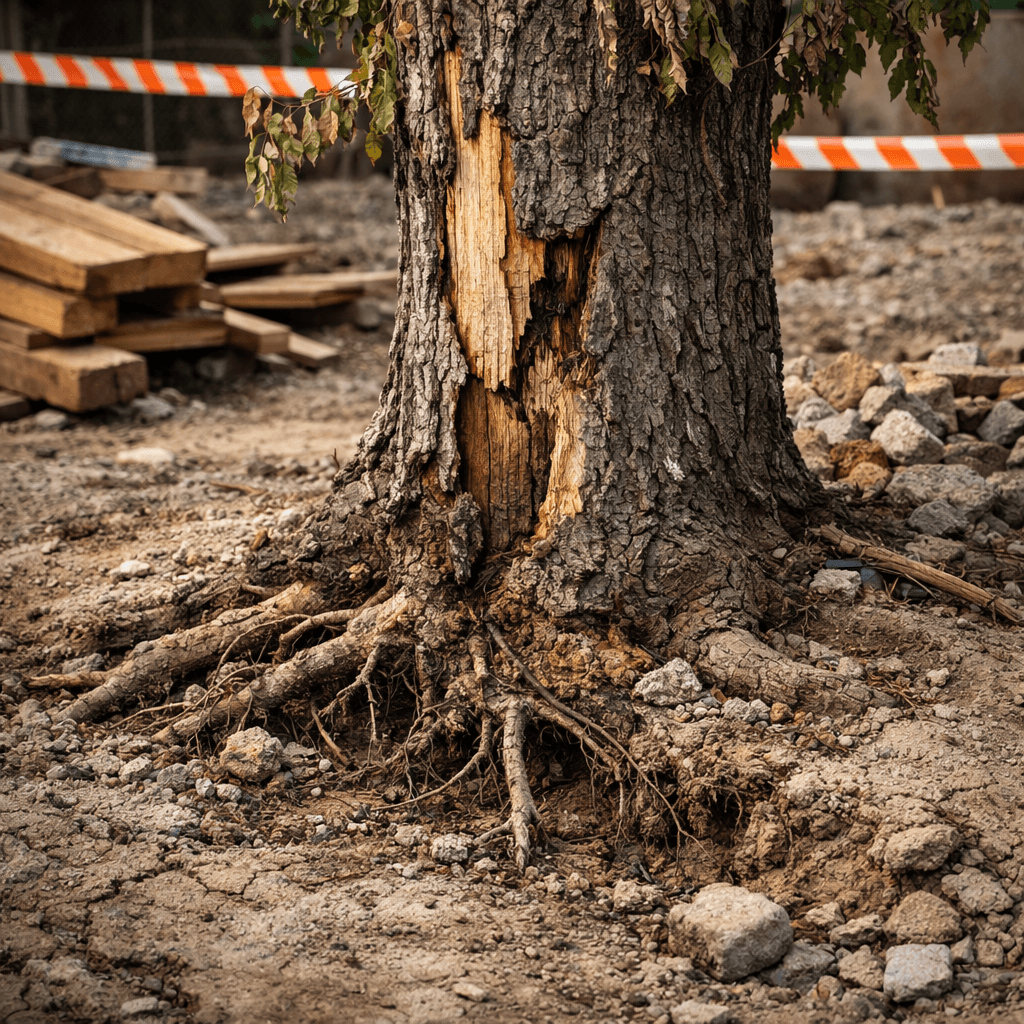
Removal is the answer when the probability of failure is high and consequences are severe, or when defects are beyond practical mitigation. Advanced basal decay with less than a third of sound wall thickness, root loss on more than one side close to the trunk, or a split that runs through the stem wood are common thresholds. Species matters too. A large willow or poplar with a major defect has a shorter margin for error than a slow-growing oak with the same defect profile. An evidence-based plan states the reasoning, addresses timing, and sets expectations for technique.

How removals are done safely and cleanly
People see the final few cuts and a stump, not the choreography that made it look easy. On tight sites, the work is closer to crane rigging and rope access than to the image of a lone person with a chainsaw.
Before the first cut, we complete a job hazard analysis. We check utilities, set an exclusion zone, and confirm that the crew has an aerial rescue plan. Every climber stays tied in with two points of attachment when cutting aloft. Ground crew keep the drop zone clear and use hand signals and radios. These are not formalities. Most accidents happen when routine blurs into complacency.
On small or open sites, we may fell in one piece with a face notch and a back cut, using wedges to control the fall. We set escape routes at 45 degrees from the intended fall line and clear footing. More often in residential work, we dismantle in sections. A climber or bucket operator ties in above the cut, sets a rigging point, and uses blocks, slings, and a lowering device to send each piece to the ground under control. For heavy wood over structures or delicate landscaping, a crane or a grapple saw truck removes sections directly, saving time and reducing risk. Each method has its place. Crane work adds cost but can prevent a single broken slate from becoming a five-figure roofing job.
Clean cuts matter even in removals. They prevent unnecessary tearing and reduce shock load on rigging. The crew uses saws matched to the cut, from 12 inch top-handles for limbing to 36 inch bar saws for big stump sections. Sharp chain, proper chain speed, and body position keep kickback zones away from the operator. These are basics, but basics well kept make complex jobs routine.
Stumps, roots, and the ground you live with
Once the standing hazard is gone, the stump remains. Stump Removal & Grinding is often the difference between a site you can use next week and a lingering eyesore. Grinding to a depth of six to twelve inches below grade is standard for lawn areas. For replanting a tree in the same place, we plan for deeper grinding and wider debris removal, since grindings mixed with soil are poor planting media. Surface roots close to driveways or patios may need selective grinding to relieve trip hazards or allow a new surface, but aggressive root cutting near structures calls for restraint. Those roots may be anchoring a nearby tree that you plan to keep.
I advise clients to backfill with a mix of topsoil and compost and to expect settling over a season. If irrigation or lighting lines run close, we mark and hand expose those sections. The grinder operator cannot see what you cannot see.
FireSmart thinking around homes and cabins
In regions prone to wildfire, FireSmart Tree Services bring a different lens to risk. The target here is the house, and the threat arrives as embers, radiant heat, and direct flame. Evidence-based steps include spacing tree crowns so that fire cannot ladder from understory shrubs into the canopy, pruning lower limbs in the first two to three meters to reduce ladder fuels, and choosing species with tighter bark and higher moisture foliage near structures. For many properties, a thinning that brings crowns three to five meters apart, paired with mulching that uses non-flammable material within the first five feet of the building, changes the odds materially. The work ties to broader landscape maintenance, but trees often hold the largest fuel load on site. Cutting the right ones and managing the rest makes defensible space real, not theoretical.
Storms, insurance, and the hours that follow a failure
When a tree comes down on a house or across a road, speed matters, but only with a cool head. I have seen well-meaning neighbors pull on a limb that was holding a stem in tension. The whole piece shifted, and a secondary impact caused the damage they were trying to avoid. The safe order of operations is simple.
- Keep people clear and assume all utility lines are live until the utility confirms otherwise
- Document the scene with wide and close photos, then call your insurer and an Emergency Tree Services provider
- If the tree is pressing on a structure, do not cut anything that is bearing weight until a controlled plan is in place
- Set tarps or temporary coverings only once the load is off and the roof or window opening is safe to access
- Keep all invoices and a chain of communication; insurers often ask for time-stamped documentation
Crews trained for storm response carry cribbing, jacks, and rigging to safely de-tension and remove stems. They also bring patience, because each move can change loads in ways that only show up on wood fibers under stress. Insurance adjusters welcome clear reports that link the event to the damage and describe the method used.
Permits, utilities, and neighbors
Many municipalities require a permit for removing larger trees, heritage species, or any tree in a protected setback. A Certified Arborist Consultation that includes a formal risk report often supports the application. If removals happen near public roads or power lines, coordination with the utility or public works is mandatory. We schedule line drops or traffic control plans weeks in advance when possible. On shared property lines, a simple courtesy notice to your neighbor with the date and nature of the work prevents surprises and can solve access issues for branches that overhang the fence.
What a professional quote should include
A good bid for Tree Removal Services reads like a plan, not a number on a napkin. It states the scope, the method, the protection measures for lawns and gardens, the plan for wood disposal, and the expected duration. It should note whether stump grinding is included, and at what depth. If we plan to use a crane, that should be explicit, along with any alternate plan if the crane cannot set up due to soft ground or weather. For pruning work, the quote should tie back to ANSI A300 and specify goals, such as crown reduction by a given percentage or clearance from structures by a set distance. For https://alexisinvo629.image-perth.org/on-call-emergency-tree-services-when-you-need-them Tree Cable and Bracing, it should name the hardware, installation heights, and inspection schedule. Vague language is often a warning sign.
Costs vary widely by region and site. As ballpark figures, a straightforward removal of a small ornamental tree may run a few hundred dollars, while a large, technical removal with crane support can reach five figures. Evidence-based assessment upfront tends to lower total costs by selecting the right remedy and avoiding scope creep.
Living with risk: setting acceptable thresholds
Zero risk is not a feasible target for a living landscape. The question is what level of risk is acceptable, given the value of the tree, the use of the site, and the owner’s preferences. I encourage a written risk tolerance statement in property plans. It can be simple. For example: We accept low to moderate risk for trees that provide shade to the patio, but we will remove any tree rated high risk that cannot be reduced to moderate within one work season. This sets clear triggers and helps family members or future owners understand why certain decisions were made.
Evidence-based assessment feeds that policy. We re-inspect after significant weather events and on a defined cycle, such as annually or every two to three years for mature, high-value trees. Young trees on a good structural pruning cycle can move to longer intervals once their primary scaffolds are set.
Edge cases that test judgment
A few scenarios deserve special mention because they create emotional and technical tension.
-
Heritage or memorial trees with documented significance. Here, the bar for removal is high. Advanced diagnostics, load testing, and staged mitigation often precede any final call. Cables, bracing, and reduction pruning can buy years when paired with target management, such as moving a playset out of the fall zone.
-
Trees with protected wildlife use. Nesting birds, bats in cavities, or raptor roosts change timing and technique. Surveys and seasonal windows govern legal work. Crews trained in wildlife-safe practices can temporarily exclude or time their cuts to avoid harm.
-
Trees near historic walls, septic fields, or fragile surfaces. Heavy equipment access may be limited. We use climbing-only removals, aluminum plates to protect turf, or helicopter lifts for rare, extreme cases. Planning and patience prevail over brute force.
-
Root damage from construction. Trenching within the critical root zone, roughly one to two times the canopy radius, can remove a third or more of absorbing roots. The canopy will not show this immediately. Evidence-based monitoring with crown density measures, soil moisture checks, and progressive reduction pruning to balance losses can keep a tree stable, or confirm that planned removal is the ethical choice before a failure chooses the time and direction.
Aftercare and replanting
Removing a dangerous tree is an end to one story and the start of another. Replanting with the right species in the right place keeps the canopy value growing. I favor a mix that spreads risk across species and ages. Diversity prevents a single pest or disease from taking out an entire street. Planting holes should be two to three times the width of the root ball, with the flare at or slightly above grade. Mulch two to three inches deep, pulled back from the trunk. Water deeply, not daily. Structural pruning starts in year two or three to set a sound framework and reduce future hazards. This is where Tree Pruning & Crown Shaping pays forward.
Soil health is part of the picture. Where removals followed decline from compaction or poor drainage, aeration with an air spade and organic amendments can restore conditions before new roots have to fight the same fight. If the site sits in a fire-prone area, align new plantings with FireSmart Tree Services principles from the start.
Why a certified arborist matters
Anyone can own a chainsaw. Not everyone brings the training, the standards, and the judgment to use it as part of a safety system. A Certified Arborist Consultation adds structure to decisions. It produces records that hold up in permit processes and insurance cases. It keeps the focus on evidence, not opinion. And when removal is the right choice, it brings a crew that knows how to do it without adding new risk.
The best praise I get is not about how fast the wood came down. It is about the quiet predictability of a plan that worked, and a property that looks cared for after the truck leaves. Trees are long-lived. Managing their risk should be thoughtful, measured, and documented.
Pulling it together: a practical path
If you suspect a tree may be dangerous, start with a brief site pause. Take in how the tree stands, what it covers, and who or what uses that space. Reduce exposure under it until you can get a professional opinion. A company that offers a full suite of Tree Removal Services, from assessment through Stump Removal & Grinding, with the capacity for Emergency Tree Services, will give you options. They can prune where pruning makes the tree safer, install Tree Cable and Bracing where it makes sense and can be maintained, and remove what cannot be made safe, all while aligning with FireSmart Tree Services where wildfire risk applies.
Ask for explanations grounded in observations you can verify, not just impressions. A strong plan reads like a set of reasons. It names the defect, the likely failure mode, the target, and the mitigation. When you hear that language, you are hearing evidence, and evidence is what keeps people and property safe.
Ace Tree Services Ltd.
Name: Ace Tree Services Ltd.Address: 4656 Wallace Hill Road, Kelowna, BC
Postal code: V1W 4C2
Phone: 250-212-9593
Website: https://acetree.ca/
Hours:
Monday: 7:00 AM - 5:00 PM
Tuesday: 7:00 AM - 5:00 PM
Wednesday: 7:00 AM - 5:00 PM
Thursday: 7:00 AM - 5:00 PM
Friday: 7:00 AM - 5:00 PM
Saturday: 7:00 AM - 5:00 PM
Sunday: Closed
Open-location code (plus code): RHF8+8G Kelowna, British Columbia, Canada
Map/listing URL: https://www.google.com/maps/place/Ace+Tree+Services+Ltd./@49.8232606,-119.4337283,659m/data=!3m2!1e3!4b1!4m6!3m5!1s0x537d8b1d074815c5:0x450b88afa7a41435!8m2!3d49.8232606!4d-119.4337283!16s%2Fg%2F11ydkpnh22
Embed iframe:
"@context": "https://schema.org", "@type": "HomeAndConstructionBusiness", "name": "Ace Tree Services Ltd.", "url": "https://acetree.ca/", "telephone": "250-212-9593", "address": "@type": "PostalAddress", "streetAddress": "4656 Wallace Hill Road", "addressLocality": "Kelowna", "addressRegion": "BC", "addressCountry": "CA" , "openingHoursSpecification": [ "@type": "OpeningHoursSpecification", "dayOfWeek": "https://schema.org/Monday", "opens": "07:00", "closes": "17:00" , "@type": "OpeningHoursSpecification", "dayOfWeek": "https://schema.org/Tuesday", "opens": "07:00", "closes": "17:00" , "@type": "OpeningHoursSpecification", "dayOfWeek": "https://schema.org/Wednesday", "opens": "07:00", "closes": "17:00" , "@type": "OpeningHoursSpecification", "dayOfWeek": "https://schema.org/Thursday", "opens": "07:00", "closes": "17:00" , "@type": "OpeningHoursSpecification", "dayOfWeek": "https://schema.org/Friday", "opens": "07:00", "closes": "17:00" ], "geo": "@type": "GeoCoordinates", "latitude": 49.8232606, "longitude": -119.4337283 , "hasMap": "https://www.google.com/maps/place/Ace+Tree+Services+Ltd./@49.8232606,-119.4337283,659m/data=!3m2!1e3!4b1!4m6!3m5!1s0x537d8b1d074815c5:0x450b88afa7a41435!8m2!3d49.8232606!4d-119.4337283!16s%2Fg%2F11ydkpnh22"
Ace Tree Services Ltd. provides professional tree removal, pruning, stump grinding, emergency response, and arborist consultations for properties in Kelowna and across the Okanagan Valley.
The company works with homes, commercial properties, and municipal settings where tree work needs to be planned carefully around buildings, fences, driveways, landscaping, and other site constraints.
Based in Kelowna, the team is positioned to help nearby neighbourhoods and surrounding Okanagan communities with routine tree care and time-sensitive storm cleanup.
Customers looking for careful tree work often want a crew with certified arborist training, insurance, and a methodical approach to higher-risk removals.
Services also include dangerous tree assessment, cabling and bracing, and wildfire risk reduction tree work for properties that need longer-term planning.
To request a quote or discuss tree care options, call 250-212-9593 or visit https://acetree.ca/.
A public map listing is available to help customers confirm the business location and get directions before a site visit or estimate.
For Kelowna property owners who need pruning, removals, or emergency tree help, a local tree service can make it easier to schedule site-specific recommendations and cleanup.
Popular Questions About Ace Tree Services Ltd.
What services does Ace Tree Services Ltd. provide?Ace Tree Services Ltd. lists tree removal, stump removal and grinding, tree pruning and crown shaping, emergency tree service, arborist consultation, dangerous tree assessment and removal, cabling and bracing, and wildfire risk reduction tree work.
Who does Ace Tree Services Ltd. serve?
The company describes its work as serving homes, businesses, and municipalities in Kelowna and across the Okanagan Valley.
Is emergency tree help available?
Yes. Emergency service is listed for downed or uprooted trees, dangerous tree assessment, stabilization work, and branch cleanup. If a tree is near power lines, the safest first step is to stay clear and contact the utility provider before any tree work begins.
Do I always need a permit to remove a tree?
Not always. Permit requirements can depend on where the tree is located and whether it is near a creek, lake, steep slope, or another protected area. It is best to check local rules for the specific property before removal work starts.
How deep does stump grinding usually go?
Standard stump grinding is typically described as going about 6 to 12 inches below ground level, which is often enough for grass or surface landscaping. Deeper grinding may be possible when site plans call for it.
How much of a tree can be safely removed at one time?
That depends on the species, age, health, and structure of the tree. In practice, good pruning is usually about removing the right limbs for health, clearance, and structure rather than chasing a fixed percentage.
What are common signs that a tree may be dangerous?
Large dead limbs, visible cracks, a new lean, root damage, canopy dieback, or storm-related damage can all be warning signs. Trees near structures deserve extra attention when any of those issues appear.
What is cabling and bracing in tree care?
Cabling and bracing are support systems used to reduce the risk of failure in trees with structural weaknesses that may still be worth preserving. They are generally used to add support, not to replace good assessment and ongoing maintenance.
How do I contact Ace Tree Services Ltd.?
Call 250-212-9593.Website: https://acetree.ca/.
Landmarks Near Kelowna, BC
Downtown KelownaThe downtown core is a practical reference point for lakefront neighbourhoods, mixed-use streets, and central residential properties. If your property is near downtown, tree pruning, removals, and cleanup can be planned around tighter access and nearby structures.
Knox Mountain Park
This well-known park north of downtown is a recognizable landmark for nearby homes and hillside properties. If you are close to this area, ask about tree assessment, trimming, or removal work suited to sloped sites.
Mission Creek Greenway
The greenway runs through several parts of Kelowna and is a useful landmark for nearby residential areas. If your property borders or sits near this corridor, site-specific tree planning is especially important.
Pandosy Village
Pandosy is one of Kelowna’s most recognizable neighbourhoods and a common reference point for south-central properties. If you are nearby, request help for pruning, removals, or storm cleanup around homes and small commercial sites.
Rutland
Rutland is a major east Kelowna neighbourhood with a mix of residential and local commercial properties. If you are located in or near Rutland, tree work can be scheduled for both routine maintenance and urgent situations.
Landmark District
This central business-focused area is a practical landmark for offices, service properties, and nearby residential streets. If your site is near the district, ask about careful tree work around parking, access lanes, and built-up lots.
Kelowna’s North End
The North End sits on the edge of downtown and is a useful reference for nearby homes, industrial sites, and commercial properties. If you are in this part of the city, request tree care based on the layout and constraints of the lot.
Airport District
The Airport District is a recognizable north Kelowna reference point for surrounding properties and access routes. If you are in this area, ask about tree services for residential acreage, commercial sites, or roadside cleanup needs.
Glenmore & Dilworth
These established Kelowna neighbourhoods are useful landmarks for central and north-central service calls. If your property is nearby, pruning and removal work can be tailored to mature trees and established landscapes.
Highway 97 Corridor
Highway 97 is one of the city’s main travel routes and a common way to describe location within Kelowna. If your home or property is just off the corridor, a clear landmark reference can help speed up quote scheduling and site planning.