Dynamic vs Static Tree Cable and Bracing Explained
Homeowners usually notice the need for support hardware the same way I do in the field, with a sharp crack after a wind event, or a seam of daylight opening in a union that used to be tight. By then, there is not much time for debate. Cabling and bracing, when done early and matched to the tree, can keep a high value specimen on your property for decades. Done poorly or applied to the wrong tree, it just delays a failure and introduces new risk. Dynamic and static systems are two different philosophies, and understanding where each fits is the difference between stewardship and sunk cost.
What problem are we solving with cables and braces?
Trees fail for a handful of predictable reasons. Codominant leaders with a narrow angle form included bark and split under bending loads. Long lateral limbs outrun their stems and peel the trunk like a zipper. Root loss on one side leaves a canopy that behaves like a sail. Decay hollows a trunk and reduces fiber strength until the remaining shell buckles.
Cabling and bracing redistribute load, limit movement, and keep defects from propagating. The goal is not to make a tree rigid. The goal is to let it move within safe limits, so fibers do not separate, hardware does not saw through wood, and weak unions do not get worse. The right support often pairs with Tree Pruning & Crown Shaping, because reducing lever arms with clean cuts lowers the demand on any hardware.
I learned this early on with a pair of mature sugar maples straddling a driveway. Both had opposing leaders, 45 degree unions, and frost cracks. The owner did not want Tree Removal Services unless we had to. We installed a simple two point cable in the higher crown, pruned 15 to 20 percent of the sail area from long laterals, and added one through rod at the union. Fifteen winters later, those trees are still greeting cars. The secret was not magic hardware, it was a balanced approach.
The two systems in plain terms
Dynamic cabling is designed to stretch slightly and allow movement. It behaves like a shock absorber, sharing loads among leaders and reducing peak forces. Static cabling and bracing are meant to restrict movement. They anchor parts of the tree so that weak wood fibers do not have to carry as much load, and they keep cracks from opening.
That difference drives everything that follows, from hardware choice to placement to how you maintain the system.
How dynamic cabling works
Dynamic systems use synthetic rope webbing and slings, often with built in energy absorbers. Brands and materials change, but the concept holds. You wrap leaders with wide protective sleeves, cinch the slings, and tension them just enough to bring partners into the same conversation. You do not drill the tree. The fibers compress slightly under load and rebound, and the absorber takes the sting out of gusts.
When a client asks for the least intrusive option, this is where I start, provided the structure can carry its own weight. Dynamic cabling shines in these situations:
- Codominant stems with minimal or no separation at the union, where fibers remain largely intact and we want to encourage incremental strengthening through normal movement.
- Long limbs that are sound but overstressed because of leverage, especially on open grown trees that see high wind exposure.
- Young to middle aged trees with good growth prospects, where we can expect the crown to reorganize over time and the need for support to diminish.
The caveat is simple. Dynamic gear is not a solution for active cracks, significant decay, or unions already opening. If I can drive a thin probe more than a few inches into a seam, or if the bark ridge has torn and the cambium has separated, the tree is telling us it cannot handle movement. In those cases, a stretch friendly system risks letting damage progress.
Dynamic cabling also brings seasonal nuance. In cold climates, ice loads jump dramatically, often to several times the typical wind bending moment. Synthetic systems tolerate shock, but they have limits. I have seen winter ice glaze on oaks that added hundreds of pounds to each limb. Before installing dynamic systems in those regions, I calculate potential loads and usually combine with crown reduction to shorten lever arms by 10 to 25 percent.
Static cabling and bracing, the backbone approach
Static systems use galvanized or stainless steel cable, thimbles, through bolts, and sometimes threaded rods placed directly through the union. You pick the cable size to match anticipated loads with a comfortable safety factor, usually 5 to 1 or better for working load limit. The system is tensioned to keep the joint from opening. Bracing rods act like internal stitches. Through bolts, not lag screws, are the standard for serious work. Old lag screw practices are widely considered obsolete because they can tear out under load.
I choose static support when the target union is already compromised. Examples include:
- A codominant maple with a 3 mm opening at the union that widens under a light prying force.
- A mature beech with fungal decay at the crotch and reduced residual wall thickness.
- A cracked union on a long limb over a roof where even small additional movement risks failure.
There is a trade. Static systems restrict movement and can shift stress to other parts of the tree. If I bolt a weak union and cable two leaders firmly together, the next failure might occur at the next node down the stem. To manage that, I set cable height as high as practical, often two thirds of the distance from union to tips, and I combine with selective weight reduction. Per ANSI A300 Part 3 guidance, you locate cables at least 30 to 100 cm below the top of the crown, depending on structure, to maximize leverage reduction without creating a stiff short lever that pries off the union.
When the defect is severe, I will stack solutions. A brace rod or two through the union to lock it, then a static cable higher up to https://spencerqyky082.capitaljays.com/posts/structural-tree-pruning-crown-shaping-to-reduce-weight reduce bending, then careful reductions. The rods keep the crack from propagating, the cable lowers the stress, and the pruning cuts reduce the engine that drives load in the first place.
Choosing dynamic or static, the decision path I use in the field
I carry a mallet, probe, increment borer, and a simple rule. If the tree can move safely, let it. If it cannot, stop the movement. The following factors guide the choice.
- Condition of the union. Is there included bark, a visible seam, or callus folding around a crack line. If the union opens when the wind hits, dynamic is off the table.
- Residual wall thickness. On decayed stems, I measure or estimate the percent of sound wood. If less than about 30 percent of radius remains as a uniform shell, hardware becomes a stopgap and I start talking about Dangerous Tree Assessment and Removal.
- Exposure and targets. A tree over a patio, a playground, or an electrical service line tolerates less uncertainty. I may choose a conservative static setup even on a marginal union when the consequences of failure are high.
- Species behavior. Willows, poplars, and silver maples grow fast and break fast. Beeches, elms, and oaks hold together better but can carry hidden decay. Species tell me how likely the hardware is to be outgrown or overloaded.
- Owner goals. Some clients value a specific tree for shade or sentiment and will accept hardware maintenance and periodic Tree Pruning & Crown Shaping. Others want low maintenance over a 10 year horizon and are better served with removal and Stump Removal & Grinding followed by replanting.
I also look beyond the union. Roots, soil moisture, lean, crown bias, and wind fetch matter. A beautifully installed cable on a tree with root plate lift signs is lipstick on the wrong animal. That is where a Certified Arborist Consultation earns its keep.
Installation details that separate good from risky
Most failures I am called to clean up after a storm have a history written on the wood. Hardware bites through bark because someone skipped a sleeve. A lag screw pulls out because it never made it to sound wood. A cable is set too low, turning the crown into a crowbar.
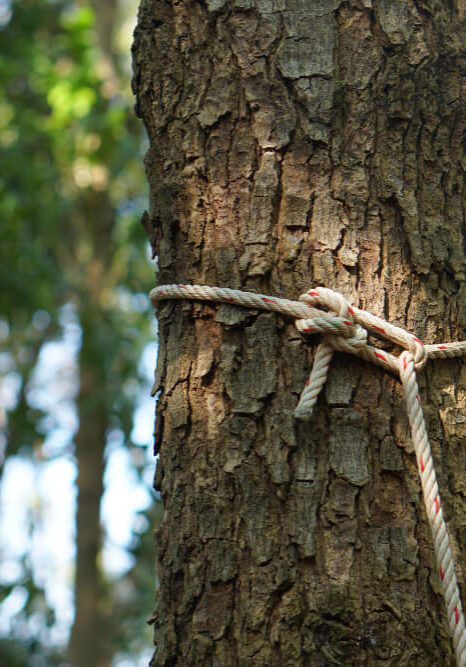
On dynamic gear, I use wide cambium protectors, often 4 to 6 cm, and I fit slings snug, not tight. I do not pre tension to pull leaders together. The system should be passive at rest and engage under load. I avoid splicing synthetic materials in the field unless the manufacturer approves and the splice seats into a tested connector. Sunlight degrades exposed synthetics slowly. I note install dates and plan replacement at 8 to 12 year intervals, sometimes sooner in high UV zones.
On static hardware, I drill clean holes undersized by a few millimeters for the rods, then back them with washers and nuts on both sides, countersunk if aesthetics matter. Cable termination uses thimbles and at least three wire rope clips per termination for small diameters, more for larger, or swaged fittings when I can bring a press. I do not use a single U bolt to pinch a loop around a hook. That shortcut fails unpredictably. Where a steel cable passes through a canopy, I install abrasion guards to avoid bark wear.
Elevation matters. The higher the cable, the more leverage it has to control movement with less force. On two leaders 10 meters tall, I aim for a cable at 6 to 7 meters. That often means climbing well past comfort zones. If you hire out, make sure the crew actually installs at the calculated height, not at the first easy crotch.
Finally, I plan escape paths for limbs under tension. When a cracked union is being braced, the wood can release stored energy like a spring. I have seen a 15 cm limb jump several centimeters when a brace rod draws fibers together. Everyone on site needs a clear lane.
The role of pruning, and how much reduction is enough
Support without pruning is half a plan. Even small cuts near the tips reduce bending moments dramatically because lever length is squared in the math. On a 6 meter limb, cutting back 1 meter reduces the lever arm by roughly 17 percent, which can drop bending stress by a third or more under gusts. I track reductions in two passes, first removing dead, diseased, and rubbing wood, then shortening a few dominant laterals to redistribute growth. Twelve to twenty percent total foliage removal is a reasonable ceiling for a mature tree in one season.
I avoid lion tailing, where all interior branches are stripped and tufted foliage left at the end. That practice increases sail at the tips and amplifies sway. A thoughtful Tree Pruning & Crown Shaping plan leaves interior structure to damp movement.
What your maintenance calendar should look like
Even the best system is not install and forget. Industry standards such as ANSI A300 recommend periodic inspection, and experience pushes me to be conservative, especially in high traffic areas.
- Inspect annually from the ground, looking for slippage, broken strands, chewed sleeves, and new cracks or swelling near hardware.
- Climb or use a lift for a hands on check every 3 to 5 years. Retension static cables if needed and look for corrosion, especially under wraps.
- After severe weather, do a quick visual. If two lines look uneven or a union has fresh sap flow or bark buckling, call for a closer look.
- Replace synthetic dynamic systems on a 8 to 12 year cycle, sooner if UV exposure is high or if abrasion is visible. Replace static cables when corrosion reaches more than superficial surface rust or when a single broken strand is found.
- Re evaluate the need for support when the tree puts on significant growth. New wood can outpace old defects, or it can outgrow sleeves and begin to pinch.
Those five points add up to a habit. I tie them to other property tasks. When gutters get cleaned in fall, look up at the hardware. When you schedule irrigation checks in spring, call your arborist for an inspection slot.
When support is not the answer
A tough part of the job is saying no to heroic saves. If decay has eaten more than half the radius at a critical union, or if we see Kretzschmaria deusta, Inonotus dryadeus, or other aggressive root and butt rot fungi, hardware often masks risk instead of reducing it. Trees with advancing lean that accelerates over a single season also move into the high risk category quickly.
When we advise removal, it is not surrender. It is managing risk with clear eyes. Dangerous Tree Assessment and Removal protects people and structures. Done properly, it also sets the stage for replanting with a species and structure less likely to need hardware. After removal, Stump Removal & Grinding keeps pests like carpenter ants from colonizing, and it clears the site for new roots.
Emergency Tree Services come into play when a supported tree still fails or when a non supported neighbor sheds a limb onto a cable line. If gear is in the canopy already, responders need to know it is there before they cut. Good practice includes tagging hardware with a small, weather resistant label at the base of the trunk and noting it on your property records.
Costs, lifespan, and what to expect over ten years
Pricing varies by region, canopy height, access, and number of anchors. As a ballpark, a single dynamic cable between two leaders at 7 to 10 meters might run 400 to 900 dollars, including light pruning. Static systems with through bolts and steel cable often range from 800 to 2,000 dollars when lifts or complex rigging are needed. Complex cases with multiple cables and rods can cross 3,000.
Lifespan follows materials and environment. Dynamic components tend to last 8 to 12 years in temperate climates. Steel can last longer, 12 to 20 years, but corrosion at terminations and under bark contact shortens that window, especially near coastal salt air or in industrial pollution. Trees do not stop growing. That growth will bury some hardware, especially bracing rods. Burying is not failure. It is normal, but it does hide inspection points, so I photograph and measure locations during install.
If you budget 100 to 300 dollars for an inspection every few years and a modest pruning cycle, you will be ahead of surprises. These numbers are small compared to the cost of roof repairs or vehicle damage after a limb goes through the wrong thing.
Two field stories that teach the difference
A red oak over a backyard pool, 70 cm trunk, two leaders with a tight 20 degree union and a faint seam. The owner noticed a rust colored streak after a windstorm. Tapping around the union, the sound was solid but brittle. We installed two dynamic slings at 6.5 meters, pruned 15 percent distributed across five laterals, and set a six month check to watch the seam. Two years later, callus bridged and the seam stopped weeping. The dynamic system still had clean sleeves, and growth rings had rolled around them. The tree learned to carry itself, which is exactly what we hoped.
A silver maple over a detached garage with a codominant at 30 degrees and a 5 mm opening at the union. The interior showed old callus ridges, clear signs of seasonal opening and closing. Static was the only choice. Two through rods went into the union, stainless because the location collected moisture. A steel cable set at 8 meters, plus a 20 percent reduction on the garage side. The first winter brought an ice storm that laid a glaze on the canopy. After thaw, the union held, but a lower lateral beyond the cable cracked at its base. We removed that lateral, and the system performed for eight years until a redevelopment plan replaced the garage, and the owner opted for removal and replanting. That decision made sense because maintenance would continue, and the tree had a history of branch failures.
FireSmart, wind, and regional thinking
In fire prone regions, FireSmart Tree Services inform pruning and support choices. Vertical separation between ladder fuels and crown, spacing between canopies, and removal of deadwood change how wind flows through your trees. I adjust cable plans accordingly. A crown opened for fire mitigation may see higher gust penetration. That can raise dynamic loads on unions by 10 to 30 percent. In those cases, I favor higher cable placement and sometimes a static system even on a marginal union, paired with more conservative pruning to maintain internal structure.
Snow and rime ice add another twist. The dense crowns of spruce and fir collect loads that broadleaf trees shed. Static cabling is rarely used on conifers because of how their wood and branching patterns handle stress, but exceptions occur on large, open grown pines with sprawling limbs. When I do support a conifer, I am meticulous with sleeve protection because bark is thinner and more easily girdled.
How this fits with a full care plan
Cabling and bracing are tools in a larger kit. A Certified Arborist Consultation should come first, with a written assessment that includes photos, measurements, and a simple risk rating. That consult may recommend:
- Tree Cable and Bracing for specific unions, with dynamic or static justification.
- Targeted Tree Pruning & Crown Shaping to reduce sail and rebalance.
- Soil and root care, including mulch, irrigation, and decompaction to stabilize the root plate.
- FireSmart Tree Services where appropriate, to meet local guidelines while maintaining structural integrity.
If risk remains high after these measures, or if defects advance, the path shifts to Tree Removal Services, followed by Stump Removal & Grinding and a replanting plan. A healthy young tree placed well, pruned correctly in its first five years, and kept out of wind tunnels between buildings is a better safety investment than any retrofit.
Questions to ask before you sign off on hardware
Hiring the right crew prevents headaches. During estimates, I look for answers that show the contractor matches the system to the tree, not the other way around.
- Which standard guides your work, and how will you document cable height, size, and hardware. ANSI A300 Part 3 is the usual reference in North America.
- Why dynamic or static in this case. Ask for a specific union assessment and how movement will be managed.
- What pruning accompanies the install, and how much foliage will be removed this season. Listen for numbers and limits.
- What is the inspection and replacement timeline. Get maintenance on the calendar now, not later.
- How will you protect cambium and manage drill holes, and what happens if previously hidden decay appears during drilling.
If a contractor proposes lag screws as primary anchors, or suggests hardware without pruning, keep looking. If they refuse to discuss removal as a legitimate option for a severely compromised tree, keep looking as well. Responsible firms offer the full range, from Tree Cable and Bracing to Dangerous Tree Assessment and Removal, and they handle emergencies without drama when the weather throws a curve.
Closing thoughts from the canopy
I have walked out on swaying limbs high enough to see a neighborhood’s entire roof line, and I have stood on the ground staring at a failed union, wishing someone had called a year earlier. Dynamic and static systems are both valuable. Dynamic respects a tree’s biology and leverages movement to build strength, but only when the wood is still trustworthy. Static imposes discipline on a structure that has lost the right to flex. Both require thoughtful placement, clean hardware, and a plan to revisit them.
If a tree matters to you, act while it is still asking for help, not yelling. Bring in a credentialed eye, build a modest maintenance habit, and integrate support with pruning and site care. The reward is simple. Years more shade where you want it, less risk where you do not, and a landscape that looks cared for rather than controlled.
Ace Tree Services Ltd.
Name: Ace Tree Services Ltd.Address: 4656 Wallace Hill Road, Kelowna, BC
Postal code: V1W 4C2
Phone: 250-212-9593
Website: https://acetree.ca/
Hours:
Monday: 7:00 AM - 5:00 PM
Tuesday: 7:00 AM - 5:00 PM
Wednesday: 7:00 AM - 5:00 PM
Thursday: 7:00 AM - 5:00 PM
Friday: 7:00 AM - 5:00 PM
Saturday: 7:00 AM - 5:00 PM
Sunday: Closed
Open-location code (plus code): RHF8+8G Kelowna, British Columbia, Canada
Map/listing URL: https://www.google.com/maps/place/Ace+Tree+Services+Ltd./@49.8232606,-119.4337283,659m/data=!3m2!1e3!4b1!4m6!3m5!1s0x537d8b1d074815c5:0x450b88afa7a41435!8m2!3d49.8232606!4d-119.4337283!16s%2Fg%2F11ydkpnh22
Embed iframe:
Ace Tree Services Ltd. provides professional tree removal, pruning, stump grinding, emergency response, and arborist consultations for properties in Kelowna and across the Okanagan Valley.
The company works with homes, commercial properties, and municipal settings where tree work needs to be planned carefully around buildings, fences, driveways, landscaping, and other site constraints.
Based in Kelowna, the team is positioned to help nearby neighbourhoods and surrounding Okanagan communities with routine tree care and time-sensitive storm cleanup.
Customers looking for careful tree work often want a crew with certified arborist training, insurance, and a methodical approach to higher-risk removals.
Services also include dangerous tree assessment, cabling and bracing, and wildfire risk reduction tree work for properties that need longer-term planning.
To request a quote or discuss tree care options, call 250-212-9593 or visit https://acetree.ca/.
A public map listing is available to help customers confirm the business location and get directions before a site visit or estimate.
For Kelowna property owners who need pruning, removals, or emergency tree help, a local tree service can make it easier to schedule site-specific recommendations and cleanup.
Popular Questions About Ace Tree Services Ltd.
What services does Ace Tree Services Ltd. provide?Ace Tree Services Ltd. lists tree removal, stump removal and grinding, tree pruning and crown shaping, emergency tree service, arborist consultation, dangerous tree assessment and removal, cabling and bracing, and wildfire risk reduction tree work.
Who does Ace Tree Services Ltd. serve?
The company describes its work as serving homes, businesses, and municipalities in Kelowna and across the Okanagan Valley.
Is emergency tree help available?
Yes. Emergency service is listed for downed or uprooted trees, dangerous tree assessment, stabilization work, and branch cleanup. If a tree is near power lines, the safest first step is to stay clear and contact the utility provider before any tree work begins.
Do I always need a permit to remove a tree?
Not always. Permit requirements can depend on where the tree is located and whether it is near a creek, lake, steep slope, or another protected area. It is best to check local rules for the specific property before removal work starts.
How deep does stump grinding usually go?
Standard stump grinding is typically described as going about 6 to 12 inches below ground level, which is often enough for grass or surface landscaping. Deeper grinding may be possible when site plans call for it.
How much of a tree can be safely removed at one time?
That depends on the species, age, health, and structure of the tree. In practice, good pruning is usually about removing the right limbs for health, clearance, and structure rather than chasing a fixed percentage.
What are common signs that a tree may be dangerous?
Large dead limbs, visible cracks, a new lean, root damage, canopy dieback, or storm-related damage can all be warning signs. Trees near structures deserve extra attention when any of those issues appear.
What is cabling and bracing in tree care?
Cabling and bracing are support systems used to reduce the risk of failure in trees with structural weaknesses that may still be worth preserving. They are generally used to add support, not to replace good assessment and ongoing maintenance.
How do I contact Ace Tree Services Ltd.?
Call 250-212-9593.Website: https://acetree.ca/.
Landmarks Near Kelowna, BC
Downtown KelownaThe downtown core is a practical reference point for lakefront neighbourhoods, mixed-use streets, and central residential properties. If your property is near downtown, tree pruning, removals, and cleanup can be planned around tighter access and nearby structures.
Knox Mountain Park
This well-known park north of downtown is a recognizable landmark for nearby homes and hillside properties. If you are close to this area, ask about tree assessment, trimming, or removal work suited to sloped sites.
Mission Creek Greenway
The greenway runs through several parts of Kelowna and is a useful landmark for nearby residential areas. If your property borders or sits near this corridor, site-specific tree planning is especially important.
Pandosy Village
Pandosy is one of Kelowna’s most recognizable neighbourhoods and a common reference point for south-central properties. If you are nearby, request help for pruning, removals, or storm cleanup around homes and small commercial sites.
Rutland
Rutland is a major east Kelowna neighbourhood with a mix of residential and local commercial properties. If you are located in or near Rutland, tree work can be scheduled for both routine maintenance and urgent situations.
Landmark District
This central business-focused area is a practical landmark for offices, service properties, and nearby residential streets. If your site is near the district, ask about careful tree work around parking, access lanes, and built-up lots.
Kelowna’s North End
The North End sits on the edge of downtown and is a useful reference for nearby homes, industrial sites, and commercial properties. If you are in this part of the city, request tree care based on the layout and constraints of the lot.
Airport District
The Airport District is a recognizable north Kelowna reference point for surrounding properties and access routes. If you are in this area, ask about tree services for residential acreage, commercial sites, or roadside cleanup needs.
Glenmore & Dilworth
These established Kelowna neighbourhoods are useful landmarks for central and north-central service calls. If your property is nearby, pruning and removal work can be tailored to mature trees and established landscapes.
Highway 97 Corridor
Highway 97 is one of the city’s main travel routes and a common way to describe location within Kelowna. If your home or property is just off the corridor, a clear landmark reference can help speed up quote scheduling and site planning.